
Heat Pump Services in Louisville & Lexington
Are you looking for an alternative heating and cooling system to replace your current furnace and AC units? A heat pump offers a comfortable and energy-efficient way to heat and cool your home, replacing both your furnace and air conditioning units at the same time.
Dauenhauer Plumbing, Heating & Air specializes in heat pump installation, repair, and maintenance services in Lexington and Louisville, Kentucky. We offer a variety of heat pump solutions to meet your specific needs.
Our Heat Pump Services
Our heat pump services in Lexington and Louisville include:
- Heat Pump Installation: Our experts will assess your home’s heating and cooling needs and budget and recommend the most suitable heat pump system. We handle the entire installation process with meticulous attention to detail.
- Heat Pump Repair: If your heat pump isn’t working properly, our technicians will diagnose the problem quickly and accurately. We use the latest tools and quality components to repair all heat pump systems, ensuring yours is back up and running as soon as possible.
- Heat Pump Maintenance: Regular maintenance is essential for keeping your heat pump running efficiently and extending its lifespan. Our heat pump preventative maintenance plans include cleaning, tune-ups, and inspections to identify and address potential problems before they become major issues.
Count on Dauenhauer Plumbing, Heating & Air for expert heat pump installation, repair, and maintenance services in Lexington, Louisville, and the surrounding areas.
Air-Source Heat Pumps: A Versatile Choice
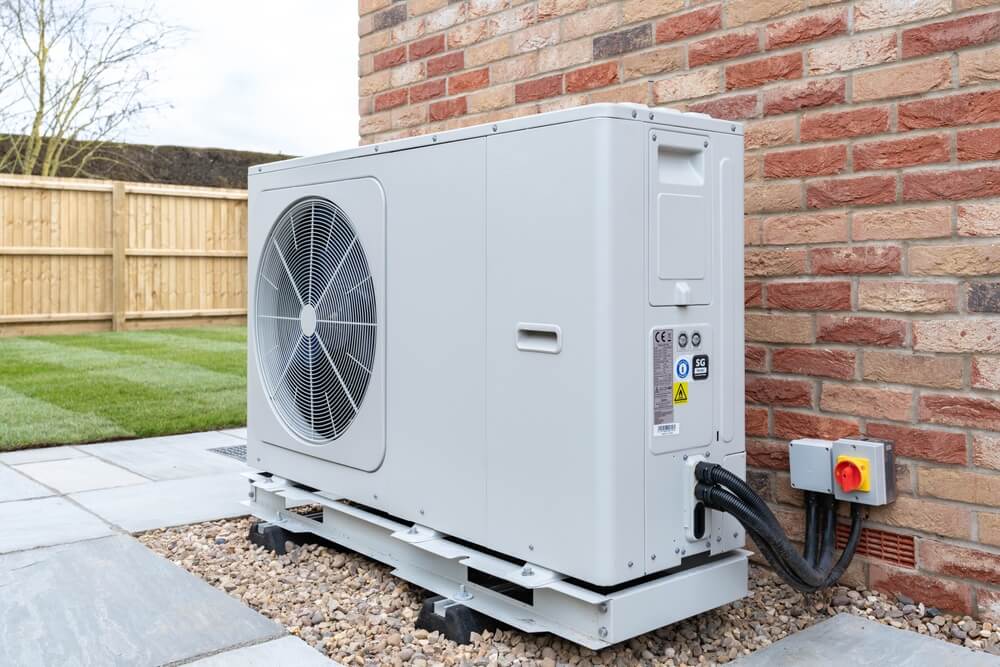
Due to their versatility, air-source heat pumps are the most common type of heat pump system. They work by transferring heat from outdoor air to your home for heating and reversing the process for cooling in the summer. Air-source heat pumps are a cost-effective option for most climates, including Kentucky.
Geothermal Heat Pumps: Tapping into the Earth’s Energy
Geothermal heat pumps utilize the earth’s constant temperature below the surface to heat and cool your home. A network of pipes buried underground transfers heat to and from your geothermal heat pump, resulting in a highly efficient and environmentally friendly system.
Water-Source Heat Pumps: Leveraging Renewable Water Energy
Water-source heat pumps extract heat from a water source, such as a well, pond, or lake, to heat and cool your home. They are a good option for properties with access to a suitable water source.
Important Note: Water-source heat pumps require careful planning and are not suitable for all locations. Consult with a Dauenhauer heat pump expert to determine if this option is right for your home.
Ductless Mini-Split Heat Pumps
Ductless mini-split heat pumps are ideal for homes without existing ductwork to provide targeted heating and cooling in specific areas. These systems consist of an outdoor unit and one or more indoor wall-mounted units.
No matter what your heating or cooling needs are, Dauenhauer Plumbing, Heating & Air has the perfect heat pump solution. Schedule an appointment today for professional heat pump installation, repair, and maintenance services in Lexington or Louisville.
Heat Pump FAQs
How does a heat pump work?
A heat pump is a refrigerant-based system that moves heat rather than generating it. In heating mode, the outdoor coil absorbs heat from the outside air (even cold air has plenty of thermal energy), the compressor raises that heat to a higher temperature, and the indoor coil releases it into the house. In cooling mode, a reversing valve flips the cycle and the system works like an air conditioner. Because the system transfers heat instead of burning fuel, efficiencies of 200–400% are typical — every 1 kWh of electricity delivers 2–4 kWh of heat. That ratio is measured as COP in heating and SEER2/EER2 in cooling.
Will a heat pump work in cold weather?
Yes, with the right equipment. Standard heat pumps lose capacity as the outdoor temperature drops, and below roughly 25–30°F many use supplemental electric resistance heat. Cold-climate heat pumps (CCHPs) — certified under the DOE/ENERGY STAR Cold Climate Challenge — are tested to maintain a COP of at least 1.75 down to 5°F, and variable-speed models with enhanced vapor injection (EVI) can hold 100% heating capacity at -5°F. Leading cold-climate brands include Mitsubishi Hyper-Heat, Daikin Fit and Aurora, Lennox SL25XPV, Bosch IDS Ultra, and Carrier Infinity 24.
What is the lifespan of a heat pump?
Manufacturer and industry data put the typical service life at 12–15 years, with well-maintained ductless mini-splits often running 18–20 years. A heat pump runs year-round (heating and cooling) where a furnace only runs in winter, which shortens life compared to a furnace — so annual professional maintenance matters more, not less.
Why is my electric bill so high with a heat pump?
The most common reasons we find during diagnostic visits in Louisville are: (1) electric auxiliary/emergency heat staying on when it shouldn’t — usually caused by a thermostat set to “EM Heat” or a miswired defrost control, (2) undersized equipment running flat-out in cold weather, (3) low refrigerant charge reducing COP, (4) clogged filter or frozen outdoor coil, or (5) the home simply switched from a cheap fuel (natural gas) to a more expensive fuel (electricity). A tune-up plus checking the thermostat program fixes the first four.


